
Using self-levelling floor compound
Self-levelling floor compound is intended to level up small surface irregularities on new and existing concrete floors - it normally comes in powder form and, once mixed with water and applied to the floor it will find its own level giving a suitable finish for laying tiles, carpet etc.
Don't expect too much from self-levelling floor compound:
- 5mm is typically the thickest it can be applied, so it won't fill deep holes in the floor.
- It is not suitable as a finished surface, you will need to lay a covering.
These comments apply to the 'general' self-levelling compounds you will find at the local DIY store; there are some specialist compounds which may not have these limitations.
Typically self-levelling floor compound is suitable for use on concrete and sand/cement screeds. If you have under-floor heating, or a different type of surface (e.g. tiles), check the products you find to make sure that it is suitable.
Preparation of the sub-floor
The surface needs to be clean, firm, dry, free of dust, dirt, oil and grease or any other contaminating. Any new concrete or screed floor must have been left to fully cure before applying the compound.
Self-levelling compound should be applied before the skirting etc are fitted; where existing skirting is in place, a better result is achieved by removing it and replacing it afterwards as this will allow the mixture to be worked into the edges and corners.
Where an existing floor shows cracks, holes or flaking, the defects should be racked out back to firm material. Large holes should be filled using a cement based filler before applying the self-levelling compound.
Sweep the floor and, if it is an existing floor, scrub it clean using water with Sugar Soap and allow to dry.
Apply a coat of concrete sealer or diluted PVA to bond the surface - start in the furthest corner from the door and work back toward it, then you won't need to tread on coated areas.
Mixing the Self Leveling Compound
Follow the manufacturers instructions; typically the mixing is by adding the powder to clean water whilst stirring (either manually or using a drill stirrer) the mixture until a creamy consistency is obtained.
Always use a clean bucket and mixing tool.
Don't mix too much compound at a time, just what you can use within 20 minutes or so (a shorter period in warmer weather) - any mixed compound not used in this time should be discarded - don't try to thin it by adding more water.
Applying the Self Leveling Compound
Always use a steel float or trowel to work the compound, a float for preference.
Pour some of the mixed compound over the floor in the furthest corner from the door - you can then work back toward the door and not tread into the coated areas. Don't pour too much onto the floor at once, you need to be able to reach across the mixture to smooth it out.
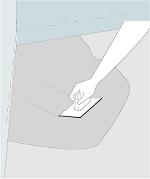 Use a steel float to smooth out the mixture to achieve a even thickness - this is hard to judge.
Work the mixture well into the corners, edges and around projections.
When you've finished spread the mixture on the floor, pour some more mixture onto the floor and spread that out and blend it in with the previous area.
Waiting for the compound to cure
Avoid draughts across the floor while the compound is curing - draughts may bring in dust and also cause the compound to cure unevenly.
The laid self-levelling compound should not be walked on until after the period stated by the manufacturer - this can vary from 1 hour to 6 hours or more, so check the packet.
The manufacturer should also recommend a period before applying the floor covering.

 Top
Top