
Spanners and Wrenches - the various types
open spanners - ring spanners - adjustable
- box spanner - socket
allen keys - torque wrench - pipe wrench - basin
spanner - tips
Spanners come in all shapes and sizes, many being developed to deal with a specific job.
By far the most important consideration when using a spanner is to ensure that it fits the nut perfectly.
Too loose, and it will round the comers of the nut - and slip, often damaging the nut.
Spanner and your hand. When purchasing spanners, select good quality tools.
The best types are forged from carbon steel or chrome vanadium, if not abused, these will last a lifetime.
Open ended - 'C' spanner
 The
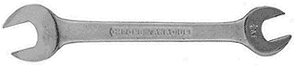
open ended spanner is the most common type, and may have a single or double end. The head has its jaws offset by about 15 degrees from the run of the shaft.
The
open ended spanner is the most common type, and may have a single or double end. The head has its jaws offset by about 15 degrees from the run of the shaft.
This is so the spanner can be turned over to engage different flats of a nut when working in confined spaces. Another version, called an obstruction spanner, is designed for use in confined spaces. It has one head set at anything up to 90
degrees to the shaft, and the shaft may have a slight curve.
Another version, called an obstruction spanner, is designed for use in confined spaces. It has one head set at anything up to 90
degrees to the shaft, and the shaft may have a slight curve.
Ring spanner
 As the name implies, the ring spanner usually has a completely enclosed head, and may have six or 12 flats. A 12 flat spanner engages upon the corners of the nut and can engage both hexagon and square bolts.
A six flat spanner is normally shaped to fit against all 6 sides of hexagon nuts, this ensures a very tight fit and can allow considerable force to be applied. Ring spanners are stronger than the open ended type, but it does need access to fit it over the nut and can take a little time to locate it correctly.
Offset ring spanner
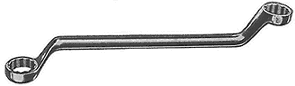 The most useful ring spanners have offset heads, allowing the spanner to connect with nuts in awkward places, and to give room for your hand to move without hitting the workpiece.
Split ring spanner
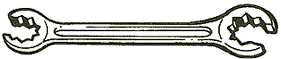 The split ring spanner is a hybrid as it has a section of the ring removed so the six or 12-point jaws can be located like an open-ended spanner.
Adjustable spanners
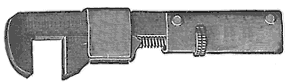 The obvious advantage of an adjustable spanner is that it will cope with a whole range of nut sizes, within the capacity of the jaws. The most common version has its jaws set at an angle of 15 degrees to the shaft, but other angles are available, including a 90 degree version. When in use, it is important to adjust the jaws so that the spanner is a good fit on the nut.
 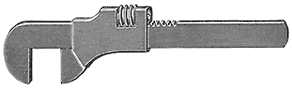 Use the spanner so the main strain is taken by the solid section of the head rather then the adjustable part. Another common version of this type is the Monkey Wrench.
Bulldog spanner
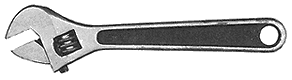 In this pattern, a worm screw is located close to the opening jaw, which has a rack engaged with the screw, making the spanner very
easy to adjust with the finger and thumb of the holding hand.
In this pattern, a worm screw is located close to the opening jaw, which has a rack engaged with the screw, making the spanner very
easy to adjust with the finger and thumb of the holding hand.
Box spanner
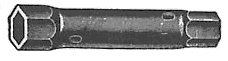 The spanner is made of tubing with flats arranged at each end. Holes through the tubing are designed to take a tommy bar set at right angles to the tube, and this is used to apply purchase to the spanner head. One of the most common types is the spark plug spanner, which may be designed to take a tommy bar, or it may incorporate a swivel handle which can be used to apply the leverage.
Socket
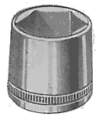 This spanner consists of a ring- type head with a square hole at the rear designed to lock into various types of handle. They are available in sets, offering a range of heads, spacer drive bars and handles. Sockets are generally required when torque wrenches are used to tighten nuts and bolts.
A variation of this design Is the wheel nut spanner which, in its simplest form, consists of two double-ended socket and spanners fixed together at right angles. Considerable pressure can be applied with this type, and care must be taken not to over-tighten.
Allen key
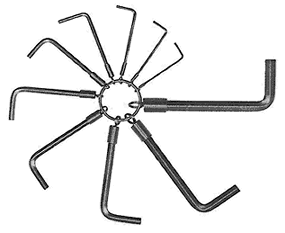 This is a simple hexagonal shaped rod with a right-angle bend designed to engage into the head of a screw which has a hexagonal shaped recess in the head - this Is a very common screw found in many modern domestic appliances. Allen keys are available in sets of metric and imperial sizes.
Torque wrench
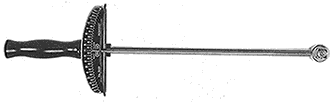 The torque wrench is used to tighten nuts and bolts to a specific torque. In the type illustrated, a pointer attached to the turning point is suspended over a scale mounted in front of the handle, as the handle is turned to tighten the nut/bolt, the arm is deflected and the pointer moves across the scale indicating the torque being applied. Torque wrenches are normally made to work with sockets.
Pipe wrenches
Although they resemble adjustable spanners, the basic difference is that the jaws of a wrench are serrated, enabling them to grip and turn objects such as lengths of pipe. The wrench should never be used on good nuts as the jaws can cause damage to the flats.
Footprint wrench
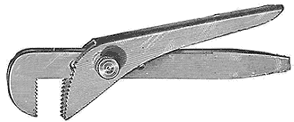 The jaw opening can be adjusted by lifting the moveable handle and re- positioning the pivot so that the wrench can be used on a number of pipe sizes. Pressure is applied by squeezing the two handles together.
Stilson wrench
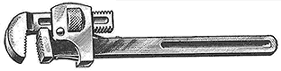 The opening jaw is controlled by an adjusting nut which, when turned, moves the jaw backwards or forwards. When pressure is applied to the handle, the jaws grip even tighter, as the handle is pivoted to the section holding the movable jaw. Pipes can be damaged by excessive pressure is applied to the handle it.
Strap wrench
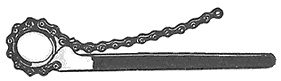 Where it is important not to mark pipework too much, the strap wrench is ideal. Instead of metal jaws, pressure is exerted via a metal chain which is wrapped around the pipework. As pressure is applied to the handle, the chain grips even around the pipe spreading the load.
Mole Wrench
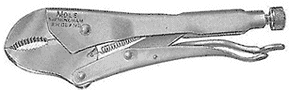 The mole is a self gripping wrench which can be adjusted to grip various diameters of pipe. The width of the jaws is adjusted by the knurled screw on the rear of the main handle and the tool is just then 'squeezed' onto the pipe. The wrench incorporates a quick release lever so that the wrench can be easily released after use.
Tap spanner
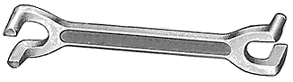 Also known as basin wrench. It is designed to tighten basin and bath taps backnuts in the often restricted space under the basin/bath where an ordinary spanner would have insufficient turning space. A basin spanner is double- ended, with cranked jaws allowing the shaft to be held vertically, gripping the nut horizontally.
USEFUL TIPS
- Always ensure that a spanner fits the flats on a nut perfectly. A loose fit will damage the nut and cause slipping.
- Where a nut is very tight, ensure your hand has a clear area of movement. The sudden release of a nut under pressure can lend to grazed knuckles.
- If a nut won't move, apply penetrating oil and allow time for it to act. The same applies to rusted nuts but wire brush it first..
- When working on chrome items, like taps, protect the metal with scraps of leather between the metal jaws. Never use pipe wrenches with serrated jaws.
open spanners - ring spanners - adjustable - box spanner - socket
Allen keys - torque wrench - pipe wrench - basin spanner - tips


 Top
Top